This expert wrote a book on Tai Chi for fall prevention—he recommends you try this exercise to build stability and improve your balance
A leading expert tells us how Tai Chi can help with fall prevention


Tai Chi is a wonderful way to add mindful movement to your day.
The ancient practice has also been shown to significantly reduce the risk of falls in older adults.
I spoke to Mark Peters, a Tai Chi expert who has worked with the UK’s National Health Service (NHS) to develop Tai Chi and qigong as rehabilitative practices (and written a book on the topic), to find out more.
First, Peters asked me to rethink falling and movement as a whole.
“The only way to move is to fall, because gravity pulls us down. You fall and catch yourself,” says Peters. “A trip is when you fall, but you can’t catch yourself. A slip is when you put your foot there, but the ground isn’t solid when you push against it.”
Peters says Tai Chi teaches you to explore the space around you and put your foot ahead of you, which in time helps to improve balance, stability and movement confidence, particularly for those prone to falls.
It’s a skill many of us haven’t developed because most people walk automatically and don’t notice how we shift our weight in a space.
The movement he recommends practicing is called ice stepping or walking on thin ice, as though you’re checking the ground ahead of you as you move.
How to practice ice stepping
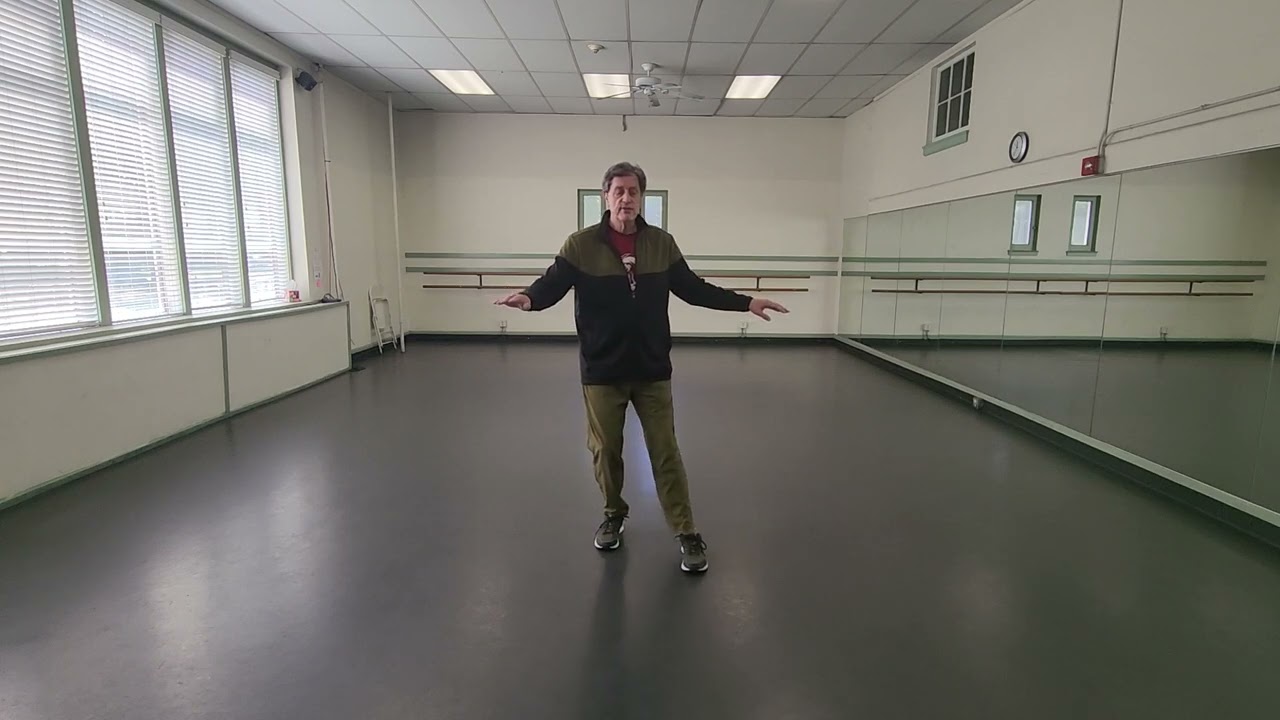
How to do it:
- Stand with your feet shoulder-width apart.
- Imagine you’re being pulled lightly from above—as though marionette strings are holding you up.
- Imagine that the floor beneath you is slippery and feels like thin ice.
- Extend your arms out to your sides for balance, but imagine they are held by marionette strings too.
- Reach your foot forward as though testing slippery ground.
- Skim your foot over the floor with your heel no higher than an inch off the floor. Keep your feet relaxed.
- Imagine the ice cracking under your foot, then move your foot back and forth until you find a solid place.
- Continue to explore the space around you.
Form tip: While it can be tempting to tense up on slippery surfaces (even if imagined), this will create more instability. Keep your limbs loose and relaxed. Imagining yourself suspended from strings can help you achieve a sense of lightness. Avoid pressing your weight into the floor—aim to walk lightly and loosely.
Why ice stepping helps to prevent falls
1. The exercise encourages mindful movement
Peters explains that this move is particularly effective because it encourages mindfulness and gets you to focus fully on the present moment.
“Your body is upright and your brain is absorbed in that moment, rather than worrying about the next step,” he says.
“You are present and mindful because you are sensing the ground and adjusting to it based on your imagination. Your brain is retraining.”
He adds that doing this practice regularly creates better movement habits.
He tells me that our bodies are an adaptive system and although the ice isn’t real, the body reacts as though it is and learns how to move in a more balanced way.
“You're allowing your body to learn and adapt without judgment,” says Peters.
By doing so in a safe, controlled environment, you can build the skills to prevent falls in more perilous conditions.
2. It improves your proprioception
Peters explains that every surface you touch offers feedback—when you touch a wall, you know you’ve done so because of the feedback through your hand.
Tai Chi takes this concept a step further and asks you to sense where your body is in space—improving your proprioception.
“Tai Chi helps you sense the ground before you move into it and that’s a major difference from how people usually walk,” says Peters. “We call it connecting to the ground.”
Instead of finding your balance once you have already taken a step, Tai Chi encourages you to find balance before you move.
“I use the term controlled instability, which means you place your foot there first, check the ground and if the ground is solid, then you move into it. If the ground isn’t solid, you move your foot somewhere else and then try again,” says Peters.
“This encourages you to connect with your whole body as you move.”

Mark Peters is a CIMSPA-accredited Tai Chi and qigong trainer, working with the UK’s National Health Service (NHS) to implement Tai Chi as a rehabilitative practice. He teaches Tai Chi for fall prevention and also offers it as a rehabilitative practice for those recovering from cardiac issues and those with chronic obstructive pulmonary disease (COPD). He wrote the Tai Chi and qigong CPD standards for the Register of Exercise Professionals (REPs) in 2010 and led the team developing the national standards with the Chartered Institute for the Management of Sport and Physical Activity (CIMSPA) in 2022.
“Effect of Tai Chi Exercise on Fall Prevention in Older Adults: Systematic Review and Meta-analysis of Randomized Controlled Trials” in International Journal of Gerontology
